The Singapore General elections is over and even though there is overwhelming support on social media for the opposition, for most of Singapore, the PAP swept the elections.
Here are a few conclusions that I could come out with:
1) Slacktivism at work -- people click on like without reading as it seems cool to participating in "opposition stuff"
2) People just want to be part of something -- they will vote the incumbent no matter what, the join in social media to participate.
3) Stupid people spoil votes -- When you put "Go home" beside the party who you not want to win, you are actually voting for them.
There was indeed many reasons, and it was an eye opener. With thousands of fans on Facebook, huge crowds during rallies, many opposition parties fail to get more than 45% of votes of Singaporeans.
Everything that they could do online, they did pretty well, and the rallies were fine, and PAP did drop the ball for many replies, and even when they failed to engage the people, they seem to do well at the polls.
Social media is clearly not enough for a party to win in an election.
-- Robin Low
Sunday, May 8, 2011

Thursday, April 28, 2011
Social media - will it translate to opposition victory?
There is much evidence that the opposition is engaging more on social media than the incumbent party. In fact, with the controlled media in Singapore, many have turned to the Internet for a more balanced view of things. There is much anger among the people as well. Many felt that the PAP is censoring comments and not reply to them online.
I believe in previous elections, the turnout was much higher for the opposition as well, and for some cases, the PAP won.
In 1988, the PAP targeted Francis Seow, a former Solicitor-General of Singapore and President of the Law Society. Mr Seow was ‘exposed’ as a serial womaniser and tax cheat, and was also accused of being a ‘foreign agent’ who was out to destabilise Singapore. Mr Seow’s WP team in Eunos GRC won 49.1% of the votes before he was hounded out of the country on trumped-up charges.
n 1991, the WP’s Jufrie Mahmood, who also stood in Eunos GRC, attracted flak for being a ‘Malay chauvinist’.
In 1997, the WP’s Tang Liang Hong, who was running with then-party leader J B Jeyaretnam in Cheng San GRC, was accused of being an ‘anti-Christian Chinese chauvinist’. Prime Minister Goh Chok Tong turned the battle for Cheng San into a personal battle, saying that voters were making a choice between him and Mr Tang, even though Mr Goh was not a candidate for the constituency.
Eventually, Mr Goh and 11 other PAP leaders, including Mr Lee Kuan Yew, Mr Lee Hsien Loong, Mr Teo Chee Hean and Dr Tony Tan, sued Mr Tang for defamation on the grounds that he said that the allegations of racism were “lies”. In doing so, they argued, he was alleging that they were “liars” and therefore unfit for office. Unsurprisingly, Mr Tang was ordered to pay millions of dollars in damages to the PAP leaders, and was forced to leave Singapore as a result.
In 2001, Dr Chee Soon Juan, the leader of the Singapore Democratic Party, was the ‘chosen one’. He was sued for defamation by Mr Goh and Mr Lee (Kuan Yew) because he brought up the issue of a clandestine billion-dollar loan to Indonesian President Suharto. Dr Chee was also branded a “heckler” and “street hustler”, and was ordered to pay more than half a million dollars in damages. He was made a bankrupt and has been unable to contest any elections since then.
And in 2006, in an incident that remains fresh in the memory of many Singaporeans, the WP’s James Gomez was accused of dishonesty and “criminal intimidation” because of a discrepancy with regards to the filing of his minority candidate form. The “Gomez Saga” dominated the agenda in the lead-up to polling day, with little attention given to the actual debate concerning national policy. Dr Gomez was detained by the police for questioning the day after the election, in which his WP team clinched 44% of the vote in Aljunied GRC.
---------------------

PAP Rally
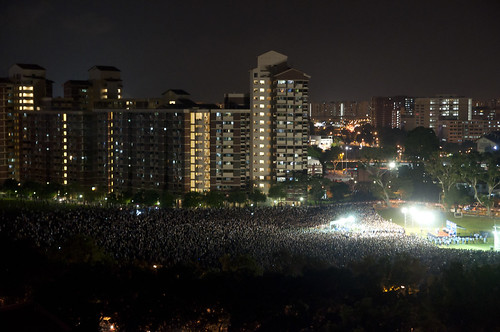
WP Rally
------------------------------------------------------
There is indeed more people interested in politics today than it was 5 - 10 years ago, and the once politically apathetic youth are participating and sharing information as well.
I have no doubt that if it is an online poll, the Opposition would win, but with the myriad conditions and rules placed, a lot of the online community, whom are Singaporeans overseas are not eligible to vote as they have not registered. (Its not even nomination day, and they were already not eligible.)
For the case of Obama, it was not only on online chatter, there was much activity on the ground and the ground coordination was very well organized and online supporters/students are activated to raise issues with their friends and families, and share what they have learned. This is not seen in Singapore yet.
So is online social media and large turnouts enough?
Only time will tell...
-- Robin Low
data from : LET THE MUDSLINGING BEGIN
I believe in previous elections, the turnout was much higher for the opposition as well, and for some cases, the PAP won.
In 1988, the PAP targeted Francis Seow, a former Solicitor-General of Singapore and President of the Law Society. Mr Seow was ‘exposed’ as a serial womaniser and tax cheat, and was also accused of being a ‘foreign agent’ who was out to destabilise Singapore. Mr Seow’s WP team in Eunos GRC won 49.1% of the votes before he was hounded out of the country on trumped-up charges.
n 1991, the WP’s Jufrie Mahmood, who also stood in Eunos GRC, attracted flak for being a ‘Malay chauvinist’.
In 1997, the WP’s Tang Liang Hong, who was running with then-party leader J B Jeyaretnam in Cheng San GRC, was accused of being an ‘anti-Christian Chinese chauvinist’. Prime Minister Goh Chok Tong turned the battle for Cheng San into a personal battle, saying that voters were making a choice between him and Mr Tang, even though Mr Goh was not a candidate for the constituency.
Eventually, Mr Goh and 11 other PAP leaders, including Mr Lee Kuan Yew, Mr Lee Hsien Loong, Mr Teo Chee Hean and Dr Tony Tan, sued Mr Tang for defamation on the grounds that he said that the allegations of racism were “lies”. In doing so, they argued, he was alleging that they were “liars” and therefore unfit for office. Unsurprisingly, Mr Tang was ordered to pay millions of dollars in damages to the PAP leaders, and was forced to leave Singapore as a result.
In 2001, Dr Chee Soon Juan, the leader of the Singapore Democratic Party, was the ‘chosen one’. He was sued for defamation by Mr Goh and Mr Lee (Kuan Yew) because he brought up the issue of a clandestine billion-dollar loan to Indonesian President Suharto. Dr Chee was also branded a “heckler” and “street hustler”, and was ordered to pay more than half a million dollars in damages. He was made a bankrupt and has been unable to contest any elections since then.
And in 2006, in an incident that remains fresh in the memory of many Singaporeans, the WP’s James Gomez was accused of dishonesty and “criminal intimidation” because of a discrepancy with regards to the filing of his minority candidate form. The “Gomez Saga” dominated the agenda in the lead-up to polling day, with little attention given to the actual debate concerning national policy. Dr Gomez was detained by the police for questioning the day after the election, in which his WP team clinched 44% of the vote in Aljunied GRC.
---------------------
PAP Rally
WP Rally
------------------------------------------------------
There is indeed more people interested in politics today than it was 5 - 10 years ago, and the once politically apathetic youth are participating and sharing information as well.
I have no doubt that if it is an online poll, the Opposition would win, but with the myriad conditions and rules placed, a lot of the online community, whom are Singaporeans overseas are not eligible to vote as they have not registered. (Its not even nomination day, and they were already not eligible.)
For the case of Obama, it was not only on online chatter, there was much activity on the ground and the ground coordination was very well organized and online supporters/students are activated to raise issues with their friends and families, and share what they have learned. This is not seen in Singapore yet.
So is online social media and large turnouts enough?
Only time will tell...
-- Robin Low
data from : LET THE MUDSLINGING BEGIN
Monday, April 25, 2011
Build trust! Don't Astroturf.

It is very important to build trust. Even when there is lack of engagement, using fake IDs to post to your page will only destroy what little you have built.
It is not hard to check on the fake profiles, and when someone found it out, well, the rest is history, and what ever engagement that was built, and reputation will all be destroyed.
I feel sorry for the 13,000 fans. How many of them are real?
-- Robin Low
Friday, April 15, 2011
Social Media Progress Report -- Singapore

Singapore has a very high Internet Penetration and mobile user base, and it is not surprising that the usage of Facebook is on the rise.
Singapore Facebook Statistics
General info
Total Facebook Users: 2 498 300
Penetration of population: 53.14%
Position in the list: 49.
Penetration of online pop.: 68.29%
Average CPC: $0.63
Average CPM: $0.35


Info from Socialbakers
As a results, there is a flurry of companies and organizations getting on Facebook. I've done some training with a few groups, and it has been going on for months and now my classes are at maximum capacity, however, for a lot of the more conservative companies, I realized that many of the companies are still not engaging in conversations, and their major concerns are still negative feedback!
People are going to talk about your company whether you are on Facebook or not. If people cannot post comments on your Facebook page, it is like telling your fans, I'm not interested to hear from you!
My friend Jeremy Woolf from Text100 shared another link: placebook Which has a map showing the number of Facebook users. Its pretty interesting and informative to look at.
He also shared the Twitter Reach

With more savvy Internet users and a highly educated population, it is strange that many of the businesses want to use social media and is afraid to get negative comments.
Well, my solution is:
ENGAGE! You need to find out the problems and solve them. Win your customers back!
Ignoring them does not solve anything!
-- Robin low
Monday, April 4, 2011
TEDxEarthquake9.0
For creating awareness and getting noticed on Social Media, participating or in the case of Carlos Miranda Levy, running TEDxEarthquake9.0 to create awareness for his Relief 2.0 and shine the light on the new Relief practices which is more inclusive, and gives survivors options.

Many of the survivors are business owners. Although they have lost everything, their homes, their stores, or even their loved ones, many are still strong, and want to restart, but they are unable to do so as they do not have enough money to do so.
This is the similar situation to many survivors in disasters all over the world. After the disaster destroys physical infrastructure, human capacity remains but it is often ignored by conventional relief efforts, and the survivors are turned into refugees.
Relief 2.0 is a new approach to Relief after a disaster, and it leverages on social media to be effective and efficient.
Relief 2.0 is the practice of running the last mile in the field through independent field units supported by mobile technologies and social networks, connecting resources, stakeholders, needs, organizations, volunteers and survivors in an efficient, effective and timely manner, filling the gaps created by bureaucracy and slow response from top-down hierarchies.
It is the result of field experience, the relentless pursuit of committed volunteers to be effective and respond to the requests of disaster survivors and the humane sympathy and empathy of global volunteers who remotely support their operation using mobile phones, community radio, the Internet and social media and networks.
In Relief 2.0 we deploy multidisciplinary and mixed small independent units of locals and foreigners, empowered to assess each situation and make decisions on their own, constantly connected and supported by mobile technologies and a distributed network of contacts which monitors and follows their activities and requests via mobile phones, SMS, twitter feed, blogs and social networks and relays any need they have to others who can in turn relay to others until the needs are fulfilled by someone in a broad network of volunteers, stakeholders and concerned institutions.
As opposed to top-down, rigid chains of command and action, these units form a distributed open network where each member has connections in multiple directions and is willing to hook up to other networks. When confronted with a a problem, each unit solves it with self initiative without waiting to be told what to do, and when unable to do so, relays the need and enables others to help.
--------------------------------------------------------
At TEDxEarthquake9.0, Relief 2.0 will be one of the talks and it will indeed leverage on the branding of the TED talks, and create a lot of awareness in the process. Many other quake related technologies will also be revealed, and there will be a simulcast in Tokyo, Singapore and other parts of the world.
TEDxEarthquake9.0 will be held on Sunday April 10, 2011 - 1pm 6pm. At Kyushu University, Fukuoka, Japan.
-- Robin Low

Many of the survivors are business owners. Although they have lost everything, their homes, their stores, or even their loved ones, many are still strong, and want to restart, but they are unable to do so as they do not have enough money to do so.
This is the similar situation to many survivors in disasters all over the world. After the disaster destroys physical infrastructure, human capacity remains but it is often ignored by conventional relief efforts, and the survivors are turned into refugees.
Relief 2.0 is a new approach to Relief after a disaster, and it leverages on social media to be effective and efficient.
Relief 2.0 is the practice of running the last mile in the field through independent field units supported by mobile technologies and social networks, connecting resources, stakeholders, needs, organizations, volunteers and survivors in an efficient, effective and timely manner, filling the gaps created by bureaucracy and slow response from top-down hierarchies.
It is the result of field experience, the relentless pursuit of committed volunteers to be effective and respond to the requests of disaster survivors and the humane sympathy and empathy of global volunteers who remotely support their operation using mobile phones, community radio, the Internet and social media and networks.
In Relief 2.0 we deploy multidisciplinary and mixed small independent units of locals and foreigners, empowered to assess each situation and make decisions on their own, constantly connected and supported by mobile technologies and a distributed network of contacts which monitors and follows their activities and requests via mobile phones, SMS, twitter feed, blogs and social networks and relays any need they have to others who can in turn relay to others until the needs are fulfilled by someone in a broad network of volunteers, stakeholders and concerned institutions.
As opposed to top-down, rigid chains of command and action, these units form a distributed open network where each member has connections in multiple directions and is willing to hook up to other networks. When confronted with a a problem, each unit solves it with self initiative without waiting to be told what to do, and when unable to do so, relays the need and enables others to help.
--------------------------------------------------------
At TEDxEarthquake9.0, Relief 2.0 will be one of the talks and it will indeed leverage on the branding of the TED talks, and create a lot of awareness in the process. Many other quake related technologies will also be revealed, and there will be a simulcast in Tokyo, Singapore and other parts of the world.
TEDxEarthquake9.0 will be held on Sunday April 10, 2011 - 1pm 6pm. At Kyushu University, Fukuoka, Japan.
-- Robin Low
Wednesday, March 16, 2011
Relief 2.0
Relief 2.0 -- Big in Japan Mission
Relief 2.0 is going to Japan to use Social Media for Relief Efforts and run the last mile.
Relief 2.0 -- Using Social Media for Relief.

About Carlos Miranda Levy
He is a Social Entrepreneur in Residence, National University of Singapore Entrepreneurship Centre.
Digital Vision Fellow, Stanford University
Founder of Educar.org, BibliotecasVirtuales.com, SocInfo.com and CIVILA.com
Social Entrepreneur, Technology, Innovation and Social Media and Development Consultant.
Developer of educational, cultural and development initiatives with high impact across Latin America and the world, focused on latin american culture and development opportunities. Currently traveling across America to work with local communities on education, ICT, environment, culture and open source workshops and practical experiences.
I don´t know much about a lot of stuff. I know some interesting things about a few things, mainly because I have been lucky to work next to a lot of people who know a lot of stuff.
----
Currently Social Entrepreneur in Residence at the National University of Singapore Entrepreneurship Centre, 2004-2005 Digital Vision Fellow at Stanford University, 2004 Google Developing World Scholarship recipient, acknowledged on 2000 by CNN as one of Latin America's top 20 most influential people on the Internet.
I have extensive field experience and given conferences and workhops in over 15 countries covering Latin America, the Caribbean, Europe, USA and Asia, in the fields of human development, public policy, education, technology, social entrepreneurship, social media and networks, creativity, innovation, and open and collaborative content since 1996. My consulting work includes ICT Public Policies, National ICT Strategies and National Education Portals funded by United Nations, World Bank, IADB and local governments in 10 countries.
My Current Work as Social Entrepreneur in Residence at the National University of Singapore Entrepreneurship Centre.
- Relief 2.0: how to effectively run the last mile and deliver relief efforts using mobile technologies, social networks and engaging local stakeholders when disaster strikes with efficiency and accountability. Visual model available at: http://www.socinfo.com/relief20/ecosystem
- Social Gaming for Social Good: how to leverage the penetration of social media and games to engage a larger audience with social issues and have a real life positive impact of their time spent playing. As in linking FarmVille to Real Farms. Visual model available at: http://www.socinfo.com/social-gaming/social-change/ecosystem
- Local Innovation and Global Entrepreneurship: A model for leveraging the competitive advantage of local factors to succeed in global markets.
- Entrepreneurs 2.0: A global collaborative network of Entrepreneurs to promote social innovation, entrepreneurial solutions to the challenges of the world and to support entrepreneurs in the developing world not limited to the exclusive conventional circles and hubs of entrepreneurship centres and universities.
My On-Line Projects: The CIVILA - Virtual Cities Network
The CIVILA - Virtual Cities - Network I founded back in 1996 engages over 4 million people throughout the world sharing and accessing content and ideas, mostly on education, literature and culture. ( traffic data: http://short.civila.com/traffic )
The main two projects are Educar.org, an education portal and network of teachers and students, and BibliotecasVirtuales.com, a lively literary community of readers and writers, with 2 million and 1.5 million active users every month, respectively ( http://short.educar.org/traffic & http://short.educar.org/map / http://short.bibliotecasvirtuales.com/traffic & http://short.bibliotecasvirtuales.com/map ).
Another project worthy of consideration is NavidadLatina.com, our Christmas site, which engages around 5 million users during the Christmas season. The rest are local sites such as RedArgentina.com, RedColombiana.com, RedMexicana.com, etc. (meaning Argentinean network, Colombian network, etc.)
My Role as Innovation Events Facilitator
- TEDx:
o I have co-hosted TEDxSantoDomingo on 2009 and 2010 (Dominican Republic).
o I was part of the organizing team of TEDxNUS 2010 (Singapore).
o I am coordinating TEDxKRP (as in Kent Ridge Park) to showcase local innovation and global entrepreneurship initiatives in Singapore and around the world next February.
- GSIF: I am also part of the organizing committee of the Global Social Innovation Forum 2010 to take place on December 2010 in Singapore.
- Entrepreneurial Events at Stanford University: I have actively collaborated with the Society for Entrepreneurship in Latin America (SELA) and the Social Entrepreneurship Showcase taking place on campus at Stanford.
Our Haiti Relief 2.0 Experience ( http://www.socinfo.com/haiti/ ): A week after the Haiti Earthquake, we started a 4 weeks stretch of 12 missions coordinated entirely through social networks (Twitter, Facebook and mobile phones), word of mouth and face to face engagement of local stakeholders, donors and institutions, eventually receiving support of famous Hollywood actors as Vin Diesel and Paul Walker and supporting the work of Universities such as Harvard and Stanford when most resources were being held or moving slowly because of bureaucratic procedures. The results were presented on a seminar we did at Stanford University ( http://www.socinfo.com/haiti/relief ), also organized via social networks. Our current Relief 2.0 ( http://www.socinfo.com/relief20/ )model being developed at the National University of Singapore in collaboration with Stanford Persuasive Technology Lab builds upon this and other experiences.
Relief 2.0 is going to Japan to use Social Media for Relief Efforts and run the last mile.
Relief 2.0 -- Using Social Media for Relief.

What is Relief 2.0
Relief 2.0 is the practice of running the last mile in the field through independent field units supported by mobile technologies and social networks, connecting resources, stakeholders, needs, organizations, volunteers and survivors in an efficient, effective and timely manner, filling the gaps created by bureaucracy and slow response from top-down hierarchies.It is the result of field experience, the relentless pursuit of committed volunteers to be effective and respond to the requests of disaster survivors and the humane sympathy and empathy of global volunteers who remotely support their operation using mobile phones, community radio, the Internet and social media and networks.In Relief 2.0 we deploy multidisciplinary and mixed small independent units of locals and foreigners, empowered to assess each situation and make decisions on their own, constantly connected and supported by mobile technologies and a distributed network of contacts which monitors and follows their activities and requests via mobile phones, SMS, twitter feed, blogs and social networks and relays any need they have to others who can in turn relay to others until the needs are fulfilled by someone in a broad network of volunteers, stakeholders and concerned institutions.As opposed to top-down, rigid chains of command and action, these units form a distributed open network where each member has connections in multiple directions and is willing to hook up to other networks. When confronted with a a problem, each unit solves it with self initiative without waiting to be told what to do, and when unable to do so, relays the need and enables others to help. --------------------------------------------
Relief 2.0 is founded by Carlos
About Carlos Miranda Levy
He is a Social Entrepreneur in Residence, National University of Singapore Entrepreneurship Centre.
Digital Vision Fellow, Stanford University
Founder of Educar.org, BibliotecasVirtuales.com, SocInfo.com and CIVILA.com
Social Entrepreneur, Technology, Innovation and Social Media and Development Consultant.
Developer of educational, cultural and development initiatives with high impact across Latin America and the world, focused on latin american culture and development opportunities. Currently traveling across America to work with local communities on education, ICT, environment, culture and open source workshops and practical experiences.
I don´t know much about a lot of stuff. I know some interesting things about a few things, mainly because I have been lucky to work next to a lot of people who know a lot of stuff.
----
Currently Social Entrepreneur in Residence at the National University of Singapore Entrepreneurship Centre, 2004-2005 Digital Vision Fellow at Stanford University, 2004 Google Developing World Scholarship recipient, acknowledged on 2000 by CNN as one of Latin America's top 20 most influential people on the Internet.
I have extensive field experience and given conferences and workhops in over 15 countries covering Latin America, the Caribbean, Europe, USA and Asia, in the fields of human development, public policy, education, technology, social entrepreneurship, social media and networks, creativity, innovation, and open and collaborative content since 1996. My consulting work includes ICT Public Policies, National ICT Strategies and National Education Portals funded by United Nations, World Bank, IADB and local governments in 10 countries.
My Current Work as Social Entrepreneur in Residence at the National University of Singapore Entrepreneurship Centre.
- Relief 2.0: how to effectively run the last mile and deliver relief efforts using mobile technologies, social networks and engaging local stakeholders when disaster strikes with efficiency and accountability. Visual model available at: http://www.socinfo.com/relief20/ecosystem
- Social Gaming for Social Good: how to leverage the penetration of social media and games to engage a larger audience with social issues and have a real life positive impact of their time spent playing. As in linking FarmVille to Real Farms. Visual model available at: http://www.socinfo.com/social-gaming/social-change/ecosystem
- Local Innovation and Global Entrepreneurship: A model for leveraging the competitive advantage of local factors to succeed in global markets.
- Entrepreneurs 2.0: A global collaborative network of Entrepreneurs to promote social innovation, entrepreneurial solutions to the challenges of the world and to support entrepreneurs in the developing world not limited to the exclusive conventional circles and hubs of entrepreneurship centres and universities.
My On-Line Projects: The CIVILA - Virtual Cities Network
The CIVILA - Virtual Cities - Network I founded back in 1996 engages over 4 million people throughout the world sharing and accessing content and ideas, mostly on education, literature and culture. ( traffic data: http://short.civila.com/traffic )
The main two projects are Educar.org, an education portal and network of teachers and students, and BibliotecasVirtuales.com, a lively literary community of readers and writers, with 2 million and 1.5 million active users every month, respectively ( http://short.educar.org/traffic & http://short.educar.org/map / http://short.bibliotecasvirtuales.com/traffic & http://short.bibliotecasvirtuales.com/map ).
Another project worthy of consideration is NavidadLatina.com, our Christmas site, which engages around 5 million users during the Christmas season. The rest are local sites such as RedArgentina.com, RedColombiana.com, RedMexicana.com, etc. (meaning Argentinean network, Colombian network, etc.)
My Role as Innovation Events Facilitator
- TEDx:
o I have co-hosted TEDxSantoDomingo on 2009 and 2010 (Dominican Republic).
o I was part of the organizing team of TEDxNUS 2010 (Singapore).
o I am coordinating TEDxKRP (as in Kent Ridge Park) to showcase local innovation and global entrepreneurship initiatives in Singapore and around the world next February.
- GSIF: I am also part of the organizing committee of the Global Social Innovation Forum 2010 to take place on December 2010 in Singapore.
- Entrepreneurial Events at Stanford University: I have actively collaborated with the Society for Entrepreneurship in Latin America (SELA) and the Social Entrepreneurship Showcase taking place on campus at Stanford.
Our Haiti Relief 2.0 Experience ( http://www.socinfo.com/haiti/ ): A week after the Haiti Earthquake, we started a 4 weeks stretch of 12 missions coordinated entirely through social networks (Twitter, Facebook and mobile phones), word of mouth and face to face engagement of local stakeholders, donors and institutions, eventually receiving support of famous Hollywood actors as Vin Diesel and Paul Walker and supporting the work of Universities such as Harvard and Stanford when most resources were being held or moving slowly because of bureaucratic procedures. The results were presented on a seminar we did at Stanford University ( http://www.socinfo.com/haiti/relief ), also organized via social networks. Our current Relief 2.0 ( http://www.socinfo.com/relief20/ )model being developed at the National University of Singapore in collaboration with Stanford Persuasive Technology Lab builds upon this and other experiences.
Monday, March 7, 2011
Beware of iPhone Auto Correct.
Beware of iPhone Auto Correct.
Here are some more reasons not to get an iPhone..





LOL!
-- Robin Low
Here are some more reasons not to get an iPhone..


LOL!
-- Robin Low
Subscribe to:
Posts (Atom)