Showing posts with label Singapore. Show all posts

Friday, April 17, 2015

Online rants turned Sedition


Amos Yee is now a know person in Singapore. His online rant on Youtube is treated by the government as Sedition, even though he was 16 years old and there was actually not much of an audience until the media decide to pick it up and make it popular.

Primarily, his rant was targeted at the late Lee Kuan Yew, and as many may know this proves to be very unpopular and there were several individuals, including a grassroots leader of the PAP threatening to cut off the boy's Penis.

Most of the time, it is State media that flamed the flames towards Amos and publicized his video. Because Amos cannot be charged saying bad things about a dead person, He was charged under sedition act, because his video contained a rant against Christians as well.

I do not believe that the use of sedition law in this case is justified. It seems to be politically motivated, even towards this 16 year old seeking attention, who is obviously no threat.

In law, sedition is overt conduct, such as speech and organization, that is deemed by the legal authority to tend toward insurrection against the established order. Sedition often includes subversion of a constitution and incitement of discontent (or resistance) to lawful authority.

Clearly, on Digital Media, the laws are still relatively new and this will set precedence and if Amos is convicted, the Sedition Act seems to be able to clamp down on any dissent online.

I've asked many Christians about the incident, and even after watching the video, they do not really feel offended, and agreed that the boy needed help. For those that felt offended, a lot of them were supporters of LKY who have not viewed the video and were all up in arms about prosecuting the 16 year old.

After engaging with 16 year olds, I realized that swearing and rebellious nature was a common thing. This has of coursed because more serious than it should and Amos may need some punishment, but clearly, this is not Sedition.

However, the Straitstimes is also used to stir up negative emotions towards the boy as "31 March that Amos’s mother, Mrs Mary, filed a police report on her son." However she did not. They painted a picture of this uncontrollable boy which must be stopped.

I would say people need to take a lot less offense of what's going on online. If you think the title offends you, why click on it and get angry?

-- Robin Low

Wednesday, September 25, 2013

Social Media is the Reason Governing is Harder #Singapore


From Today Singapore where replies are disabled, showing how eager the government is listening to the citizens.

Previously, Singapore can ignore the coffee shop talks as they control and still control all forms of media. Ranked 149/179 on Press Freedom, Singapore has always struggled in winning views.

On Social Media, China, Vietnam, Sri Lanka have a lot of angry people online, and Singapore have their fair share. The fact that in many of these controlled countries with poor press freedom, views are very polarized and there are many hurtful remarks as many of these people use fake IDs.

In the US, you do get the occasional troll, however, there are a lot of constructive feedback as well.

I would say, the reasons why many people criticize about your government or your company is mostly because they do care. They want to share their views, and if you can actually share the reasoning behind your opinion, some may understand and you can win some over.

I must say the Prime Minister is trying to communicate, and I must be supportive of him trying. However, I do have some opinions to share.

Social Media being quick and real time, is actually a great opportunity for you to improve your government. If you truly want to engage, you will find that your actions and words, though gets analyzed by everyone, and critique by everyone, the bright side is that you can get instant feedback. To humanize is very important. If you reply transparently, share thoughts and confess to errors, people can see the human side and forgive. However, demonizing people who do not agree with you does not help at all.

On Social Media, we communicate. We do not wait for the best super-rationale, non-emotional and politically correct answer. It feels detached, scripted and formal. Proper engagement can gain trust and relevance. Policies can be crowd-sourced and co-created. If you want people to engage, you must listed to people, and take in both the good and bad. And most importantly, take actions that can regain the trust of citizens. (yes, even those on social media)

-- Robin Low

Wednesday, April 3, 2013

10 reasons why throwing money does not solve anything.

Singapore wants to be a financial hub, a knowledge hub, high tech hub, bio-medical hub, and now an aeronautical design hub and a social business hub. Singapore plans to spend $$$ to make it happen, to attract a lot of foreign companies to come in.


I've seen a lot of money spent on projects, and not much success, yet more money is thrown in. The following are some of the reasons why I think there will not be much success even if the government throws in more money in this path.

1) Good talents are not appreciated.

Software developers, Engineers, Bio-medical researchers, Industrial designers, Social Entrepreneurs are not really respected much. In Asia and Singapore, most of the time, you are respected by the car you drive, the house you own, and the salary you draw. Even if you may create a lot of social impact, the Singaporean society does not care much for it.

Talented Software developers, industrial designers, engineers do not get their fair salary, as a result, these trained people would rather go towards a managerial role, to be an IT manager, or project manager, which pays more and gets more respect, but nothing much to do with technical skills.

2) High Supply of IT graduates from Asian Countries.

India and China are producing an enormous amount of IT graduates every year. A good engineer or software developer is nothing more than just a number. So these jobs becomes some what a commodity.

3) Low demand for real talent in these developing industries.

With the IT, engineers in large supply, and the start of these new industries in Singapore, there is still not really a lot of pick up for these workers, hence the low salary. There may be an initial surge when the company is desperate to look for these staff, but once they have enough, the salary become stagnant.

4) Local companies in Singapore do not really invest in technology.

Even with the great push from the government, SMEs do not really use technology much, most SMEs are not even online, let alone use technology to solve their problems. Hence there is also relatively low demand for good talents.

Many company complain about software developers being hard to find, but that is because the skills that they need are obsolete, too old to maintain a legacy IT system, or the skill set is too specific, because everyone is following a trend, and hiring the same people. However most of the time, these companies do not want to pay for talent. $2000 per month in Singapore will not get you much of a programmer, though you may get one who claims to have a lot of experience, but may rarely deliver. Even when the business is paying a lot for rent, they rarely pay enough for labor in Singapore.

5) "Kiasu Culture"

Although Singapore government wants Singapore business to be market leaders, like the next Silicon Valley, designing new cars and forms of transportation for the world and discovering new cures to save humanity, the fact is, the price of failure is still too "high"

The risk adverse nature of Singapore does not approve of "radical projects" and most things need to be "proven" before funding can proceed. If things are proven, then how are they new and cutting edge?

6) Lots of laws, rules and regulations

When Singapore invites a foreign company to come, it is rarely straightforward. Such invitations often come with lengthy paperwork, some promise of funding which may or may not materialize and an application process which takes months or years, and may somehow fall apart when the next "scholar" boss does not agree with his predecessor.

There may be much willingness to innovate, but the laws and regulations are very tight. In the finance industry, there is so much room to offer more value with IT innovation, but the whole product when it finally completes have too much "safety" built in, that it can actually make online banking, a VERY negative experience which you have to call the customer support constantly to get new passwords and reset the account after 1 month of inactivity.

7) Low technical skills in higher management.

Most companies are run by people with MBAs rather than MEng or MSc. There may be good management skills however, a lack of technical abilities may make it hard to understand the challenges and may not allocate enough resources.

It takes good technical expertise to recognize and promote technical talents, and since managers are the ones who recruit and promote, this may lead to a vicious cycle.

8) Startups run really lean

In Singapore, there is a large push for various startups, but they rarely have enough funding to pay sufficiently. Without enough capital, without enough seed funding, it is hard to get the right talents to succeed.

If you are a really good software developer or a designer, with today's global economy, it may not be that hard getting paid a good amount overseas, rather than starting your own company in a country that does not fund you enough, and have a lot of red tape in your way of success.

Even if you have a successful innovative product, the market in Singapore may also be too small to sustain your high tech innovative company. Otherwise, the SMEs are not ready to use your technology as well. Market is not here.

9) Higher burn rate

Cost of living is really high here. Salaries not so. The jobs that get high salaries in Singapore is often in Banking or Real estate development. Technical skills not so in high demand. If you have a talented team with a low budget, if you can relocate to the neighboring countries, like Malaysia, you can stretch out your budget for much longer.

There is not much advantage to develop the latest technologies in Singapore, especially when there is not a big enough market here for it. Cost of food, rents, transportation is simply too high, even higher than New York City or Silicon Valley.

10) The people funding don't know what's going on

In the government, the people in charge rarely know what they are funding, and as they are scholars or directors in charge, they must "Pretend" to know. Not saying that all Army Generals with a Masters of Arts in Literature does not understand Bio-tech, the people in charge of funding are neither researchers, entrepreneurs or software developers.

They care about their KPIs which may be linked to "innovation and high tech" which they know nothing about, as a result, they fund projects who are mentored by their friends or people they know, rather than on real merits on things they don't understand.

-------------------------------------------------------------------------------------

I am just generalizing based on my experience, and I am sure there are cases of success out there. I do feel that the government budget for education is too low, and there should be more focus on having low cost offices and incubators that can have rent controls, rather than funding unworthy projects.

There should also be more people in different industries coming together and discussing collaborations and cross overs as I think that is where innovation occur now -- cross discipline, rather than just deep specialization in one area.

Singapore has it strengths, and what makes us different, makes us better, when you copy others, you rarely can be a leader. When you spot a trend, it is already too late. Create the trend.

-- Robin Low

Wednesday, September 14, 2011

Some Social Media Courses in Singapore in September.

Social Media Unleashed
Capitalizing on Social Media to Unleash Your Brand and
Enhance Customer Relationships

Social Media Unleashed


Social Media and Public Engagement
Master the Art of Trend Spotting & Crowd Sourcing through Customer Interaction


Social Media and Public Engagement

Friday, August 12, 2011

Curry Incident


Right before the National Day in Singapore, This news report came out.
Number of neighbour disputes hit high

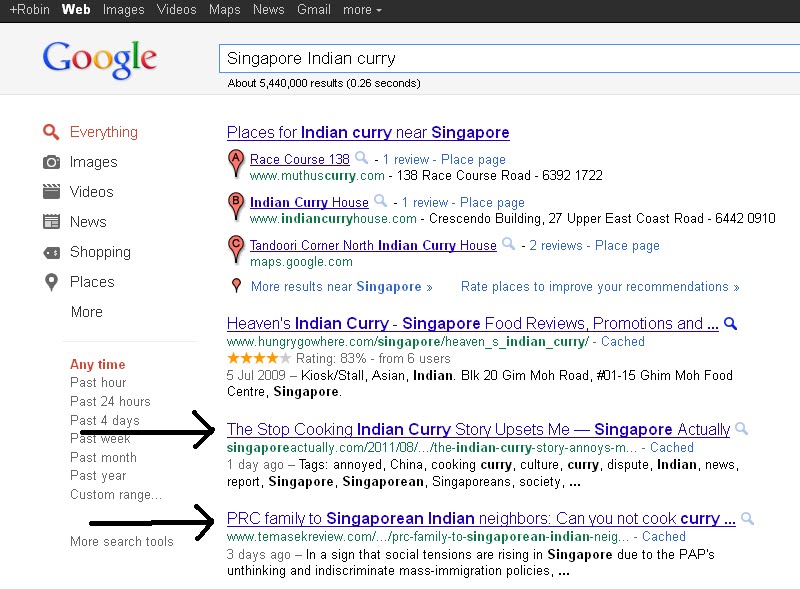
I have posted the whole report below, but there is a SOCIAL MEDIA CRISIS brewing when you search for Singapore Indian Curry on Google, you actually get this:


There are a few weak attempts to try to resolve the incident, and the government is still using traditional PR methods, "Mediators are a neutral third party"

There seemed to be no attempts to engage in the current conversations and address the problem. I understand that there are "Hard Power" approach, however, I feel that the government has to start engaging the public and use "Soft Power" to influence and build trust.

For one, a quick response in the comments to address the concerns would be much appreciated by the public, but it seems that since the elections is over, there is much less interest in attempts to please the needs of Singaporeans.

-- Robin Low


Here is an excerpt of the News Report (Copied and pasted before any edits by the Newspaper)

"Number of neighbour disputes hit high

Neighbours lack communication and increasingly intolerant: CMC
by Quek Sue Wen Carolyn
04:45 AM Aug 08, 2011
SINGAPORE - From dripping laundry to obstruction at common areas to the cooking of curry, there have been more than 300 cases a year since 2008 of warring neighbours taking to mediation to iron out their differences.

Last year, the proportion of neighbour disputes handled by the Community Mediation Centre (CMC) hit a high - with such cases making up two thirds of the total case load. And the trend has not escaped the attention of the authorities.

Responding to Today's queries, a Housing and Development Board (HDB) spokesman said that it is currently reviewing its penalty framework for public nuisance and is consulting views from various stakeholders.

The spokesman added that the authorities will take enforcement action, as a last resort, if the disturbance in question affects the neighbourhood, and when all efforts to resolve the matter amicably have failed.

The spokesman said: "In such instances, the HDB may initiate legal action to compulsorily acquire the flat or impose the penalty."

The CMC is the main mediation body here for social, community and family disputes that do not involve a seizable offence.

Out of the 498 cases seen by the CMC last year, 67 per cent were neighbour disputes, an increase from the 2007 where such disputes only made up 50 per cent of the centre's caseload. (see table)

According to the CMC, 75 per cent of these mediated neighbour dispute cases usually reach settlement.

Still, according to two CMC volunteer mediators - who have about 13 years of experience presiding over 200 cases each - neighbours are getting increasingly intolerant of each other and pick on trivial matters at times. There is also a lack of communication, so when conflicts arise, they would rather seek a third party than settle the matter themselves.

Madam Marcellina Giam, 54, a CMC master mediator, told Today: "I feel (neighbours) are less tolerant these days and they are bringing very small neighbourhood disputes to the CMC like disputes over a few pots of flowers or washing the corridor, which never used to happen."

Fellow master mediator Thirunal Karasu Palaniappan, 49, added that unlike in the past, when the "kampung spirit" was strong and neighbours ventured into each other's homes freely, many neighbours now do not know each other.


A silver lining

Most of the cases the mediators have seen are between neighbours living in public housing, though they have handled some cases involving residents of private estates. About 80 cases the CMC saw in the past two years were also referred to it by the HDB. This is out of the 1,700 complaints on inconsiderate neighbour behaviour the HDB receives on average in a year.

Mediators are also seeing more disputes involving new immigrants. Both mediators felt that most of the cases they see could be easily solved by the neighbours themselves but the latter choose not to.

As a dispute can usually take up to one hour to resolve and in one session, they said this showed how all that was needed was face-to-face communication to settle matters amicably.

While mediators are seeing a greater proportion of neighbour disputes among the cases that they handle, the good news is that fewer neighbours are taking the legal route to resolve their differences.

According to the Subordinate Courts, with the introduction of a more rigorous and proactive case management and pre-trial process last year, a majority of magistrates' complaints - which include neighbour disputes - have been resolved without the need for a full trial.

In 2009, there were 4,569 magistrates' complaints filed but this dropped by 412 complaints to 4,157 last year. In the first six months of this year, there were about 1,800 magistrates' complaints.

This translates to fewer cases in the Neighbourhood Court, a dedicated court set in 2008 solely to deal with neighbour disputes.

"Frivolous and unmeritorious complaints are weeded out at an early stage while the rest are settled by way of mediation, which has been very successful," said a Subordinates Courts spokesman.

When neighbours disagree ...
by Quek Sue Wen Carolyn
Case 1: A family, who had just moved here from China, had resorted to mediation because they could not stand the smell of curry that their Singaporean Indian neighbours would often cook. The Indian family, who were mindful of their neighbour's aversion, had already taken to closing their doors and windows whenever they cooked the dish, but this was not enough.

"They said: 'Can you please do something? Can you don't cook curry? Can you don't eat curry?'," said Madam Marcellina Giam, a Community Mediation Centre mediator. But the Indian family stood firm. In the end, Mdm Giam got the Indian family to agree to cook curry only when the Chinese family was not home. In return, they wanted their Chinese neighbours to at least give their dish a try.


Case 2: A 40-year-old sales manager was shocked to find a note posted in one of the lifts of his Telok Blangah block. The anonymous writer had complained that his children were making "ear-piercing screams everyday and making the environment very unconducive for resting". The writer said the screams were "hurting the ears" of the residents and called on the children's parents to be "socially responsible".

The sales manager, who wanted only to be known as Mr Su, said he thought of responding and finding out who the letter writer was. He decided against it eventually. "I don't know why the writer had to do that, he could have approached me directly," Mr Su told Today.

He has also told his two sons aged three and five not to make too much noise when they play. Mr Su also said he will let the matter rest - provided it does not happen again. Carolyn Quek"


Its on Bloomberg now!

Sunday, May 8, 2011

SG elections 2011

The Singapore General elections is over and even though there is overwhelming support on social media for the opposition, for most of Singapore, the PAP swept the elections.

Here are a few conclusions that I could come out with:

1) Slacktivism at work -- people click on like without reading as it seems cool to participating in "opposition stuff"

2) People just want to be part of something -- they will vote the incumbent no matter what, the join in social media to participate.

3) Stupid people spoil votes -- When you put "Go home" beside the party who you not want to win, you are actually voting for them.

There was indeed many reasons, and it was an eye opener. With thousands of fans on Facebook, huge crowds during rallies, many opposition parties fail to get more than 45% of votes of Singaporeans.

Everything that they could do online, they did pretty well, and the rallies were fine, and PAP did drop the ball for many replies, and even when they failed to engage the people, they seem to do well at the polls.

Social media is clearly not enough for a party to win in an election.

-- Robin Low

Friday, April 15, 2011

Social Media Progress Report -- Singapore


Singapore has a very high Internet Penetration and mobile user base, and it is not surprising that the usage of Facebook is on the rise.

Singapore Facebook Statistics
General info
Total Facebook Users: 2 498 300
Penetration of population: 53.14%
Position in the list: 49.
Penetration of online pop.: 68.29%
Average CPC: $0.63
Average CPM: $0.35


Info from Socialbakers

As a results, there is a flurry of companies and organizations getting on Facebook. I've done some training with a few groups, and it has been going on for months and now my classes are at maximum capacity, however, for a lot of the more conservative companies, I realized that many of the companies are still not engaging in conversations, and their major concerns are still negative feedback!

People are going to talk about your company whether you are on Facebook or not. If people cannot post comments on your Facebook page, it is like telling your fans, I'm not interested to hear from you!

My friend Jeremy Woolf from Text100 shared another link: placebook Which has a map showing the number of Facebook users. Its pretty interesting and informative to look at.

He also shared the Twitter Reach

With more savvy Internet users and a highly educated population, it is strange that many of the businesses want to use social media and is afraid to get negative comments.

Well, my solution is:

ENGAGE! You need to find out the problems and solve them. Win your customers back!
Ignoring them does not solve anything!

-- Robin low

Friday, June 25, 2010

Twitter 2010 (Singapore)

Many companies that previously overlooked Twitter have to relook at it again. Since 2008, there is simply an increase in the number of users on Twitter, In a recent research done in April 2010, there are 105,779,710 users on Twitter and the numbers are definitely growing, especially in Asia.


From the report, in Singapore, there are 930,861 users, and with a population of 4.6 million people, this is easily 20% of your population. However, the majority of this number of users are Gen Y, and with growing affluence, this market segment does have significant buying power.

A research done by Michael Netzley on the behavior of Singaporeans online, conducted by students on their friends and family yield the following results.


His findings are as follows:

1. The results from 2010 are extremely similar to 2009. I am reading this consistency as corroborating evidence of our 2009 survey. Gen Y demonstrates that it is very different from Gen X (a generational shift here comparable which, in my mind, is comparable to the U.S.'s generational shift between Gen X and Baby Boomers). Internet users in Singapore continue to consume content and observe while showing comparatively little desire to post original content (UGC). In other words, remaining in the shadows appears to be common behavior. And as we have seen in other commercial reports, social networking and watching online videos are popular online activities.
2. Twitter grew 308.5% in 2010 as compared to 2009. Still, only 47% of netizens are using Twitter each week, so the impressive uptake must be kept in a proper perspective since slightly fewer than 1 out of 2 netizens here are using Twitter.


Still Singapore enjoyed moments of popularity when Orchard Road flooded on 16 June 2010. There were many blogs talking about the flood, and "Orchard Road" became a trending topic at 9:30am.


When there was a suicide at Bedok MRT Station a few weeks back, Twitter was also flooded with Singapore Tweets about Bedok MRT.

I do believe that there is incredible potential for Twitter in Singapore and leveraging on Twitter to spread word of mouth. If your target demographics is Gen Y, and you have snazzy interesting tweets, spreading the news using Twitter in Singapore may prove to be a breeze!

-- Robin Low

Tuesday, June 8, 2010

Social Media in Singapore

I've noticed social media activities increasing in Singapore. As a social media trainer, I have been getting more requests for training.

A report by ZDnet: S'pore firms top social media adoption has results from a survey done, showing that the number of businesses engaging in social media is much higher that the global average.

After interacting with numerous companies in Singapore on social media, I observed that the larger organizations which are bureaucratic cannot implement social media well as there are still many layers of management for a decision to be made. However, many SMEs are very nimble and with little help, many of them can manage their social media activities well.

I believe the number of users on social media is also on the rise, hence it is imperative for a business to get onto social media. However, there may be pitfalls if it is not managed properly as I've seen many companies still broadcasting offers and ads on social media channels, turning off their fans and followers.

In time, I believe that social media would be just like email today -- a form of communication. However, the early adopters may be much further ahead and gain much more of an edge over the competition.

-- Robin Low

Monday, June 7, 2010

Facebook overtakes Google in Internet Traffic in Singapore

Singapore: Social Networks continue to trump Search Engines


The popularity of social media is definitely growing as more and more people get onto Facebook, Twitter and LinkedIn. More companies are also getting into engaging the public with social media, with some doing very well, and others missing the point.

The high Internet penetration of about 75% in Singapore makes the growth of social media easy as there is much availability of 3G enabled devices. It is no wonder local companies are getting onto the bandwagon.


The major media channel -- XINMSN, a collaboration between Mediacorp and Microsoft is recently launched to try to get into video sharing and social media.

When Google (search engine) has lost out to Facebook, and with the popularity of social media still growing, it is imperative for corporations to think about social media policies and make social media one of their channels of communications.


With large companies, with plenty of market research getting onto social media, if your company is in South East Asia, shouldn't you jump on the bandwagon too?

-- Robin Low

Monday, April 5, 2010

Some PR on Digital Media Academy

We are on the news today.

Singapore companies want to get on social media.

SINGAPORE, Apr 5, 2010 – NUS Extension School offers hands on social media course to train executives to leverage on social media for corporate branding. Unlike short workshops that often leave participants at a loss on how to start, full courses will prepare executives, train them to use the most popular social media tools and develop strategies to leverage them for branding.

Many companies are looking for training to participate in social media. Today in Singapore, there are more than 1 million Facebook users and 3 million Internet users -- getting on social media becomes a necessity to stay in pace with competition.

With more than two-thirds of the population in Singapore using the Internet, and with the use of broadband on mobile phones are on the rise, the number of people in Singapore participating in social media will definitely increase.

Web 2.0 tools have empowered users to create content. With Facebook over 400 million users (February 2010), 55 million people on LinkedIn, 75 million people on Twitter, more than 200 million blogs, and with the help of search engines, Internet users can easily find information they need from other users.

Today, consumers are more immune to advertising. There are more channels on radio and television that every before, and less reader reading the ever more selection of printed media. Consumers are bombarded by so much advertising that they are trained to tuned them off and ignore them, making advertisements less and less effective. Consumers are also getting more informed with plenty of global choices available as information can be readily found on the Internet.

“Customer engagement is key in today’s Web 2.0 world.” Robin Low, a Social Media Trainer at NUS Extention says. “The paradigm has shifted from feeding information to facilitating user created content, making information relevant to your customers. And leveraging word of mouth is key to a company’s success.”

Wednesday, March 10, 2010

Leveraging Social Media as Business Tool


This presentation is part of my series of talks in Singapore on Social Media.

This was done on 9 Mar, 2010 at NUS Alumni house.

Special thanks to the Office of Alumni Relations and Lisa Marie Lip Ka Ai for making this talk successful.


-- Robin Low